
Holding Deposits in 2025: A Guide for Landlords

- What is a Holding Deposit?
- How Much Can You Ask For?
- The 15-Day Deadline (Default "Deadline for Agreement")
- When Do You Have to Return a Holding Deposit?
- When Can You Keep a Holding Deposit?
- Best Practices for Handling Holding Deposits
- Consequences for Getting It Wrong
- 2025 Updates: What’s New (and What’s Not)
- Final Thoughts
Holding deposits can be a handy tool for landlords to secure a prospective tenant’s commitment while you sort out references and paperwork. But since the Tenant Fees Act 2019, there are strict rules on how much you can ask for, how long you can hold it, and when you must return it. In 2025, these rules are still in force – and understanding them will help you avoid penalties and keep things fair and legal. This guide breaks down the key points in an informal, landlord-friendly way, with links to official guidance for more detail.
What is a Holding Deposit?
A holding deposit (sometimes called a “holding fee”) is a sum of money – up to one week’s rent – that a tenant pays to reserve a property before the formal tenancy begins. By taking a holding deposit, you’re agreeing to hold the property for that tenant and stop marketing it to others. Essentially, it shows the applicant is serious and gives you both some breathing room to carry out reference checks and prepare the tenancy agreement.
Once you receive a holding deposit, you should stop advertising the property and you cannot take another holding deposit for the same property at the same time. In other words, one property = one holding deposit. (You can only accept a second holding deposit if the first applicant’s deposit is forfeited or returned and the deal falls through.)
Why take a holding deposit at all? From a landlord’s perspective, it filters out tenants who aren’t committed – if someone is willing to put down money, they’re likely genuine. It also compensates you (to a limited extent) if the tenant backs out last-minute, and covers your time and opportunity cost of holding the property off the market. However, holding deposits are optional – you don’t have to take one, and you might decide to proceed without it in some cases (for example, if the tenant can move in very soon or you trust their commitment).
How Much Can You Ask For?
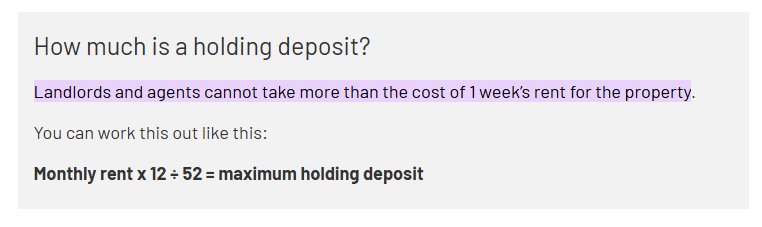
The Tenant Fees Act strictly caps holding deposits to no more than one week’s rent for the property. If you charge even a penny over one week’s rent, that excess is an unlawful fee. One week’s rent is calculated by taking the annual rent and dividing by 52 (or monthly rent × 12 / 52). For example, if the rent is £1,200 per month, the maximum holding deposit you can ask for is £1,200 × 12 / 52 ≈ £276.92.
👉 Tip: It’s good practice to be transparent with prospective tenants about how you calculated the holding deposit. Most landlords just round down to a neat figure under the one-week cap. Always provide a receipt or written acknowledgment of the holding deposit that notes the amount and date received.
The 15-Day Deadline (Default “Deadline for Agreement”)
When you take a holding deposit, a countdown clock starts ticking. By law, you have a default of 15 days to “reach an agreement” (i.e. sign the tenancy or decide not to). This 15-day period is often called the “deadline for agreement.” You and the tenant can agree in writing to a shorter or longer deadline, depending on circumstances. For instance, you might set a two-week deadline if you know referencing will be quick, or agree to extend a bit longer if you’re waiting on documentation. Make sure any extension is documented in writing (an email will do), so everyone is on the same page.
If the 15 days pass (or your agreed extended deadline passes) without a tenancy agreement being signed, you generally must return the holding deposit to the tenant in full within 7 days unless a specific exception applies (we’ll cover exceptions below). In practice, if things are taking longer, it’s often better to mutually agree a new deadline date rather than let it expire and have to refund the money and possibly start over.
When Do You Have to Return a Holding Deposit?
In many cases, the holding deposit will need to be refunded to the tenant. Here are the scenarios where you must return it (in full):
- Tenancy goes ahead: If you and the tenant enter into the tenancy (they sign the contract and move in), you should either return the holding deposit or, more commonly, apply it towards the first month’s rent or security deposit (with the tenant’s agreement). Essentially, the tenant should get the money back by it being deducted from what they owe at move-in. The law requires that if the tenancy is agreed, the holding deposit cannot just be kept on top – it has to be repaid or used toward rent/deposit. Most letting agents will automatically put the holding deposit toward the initial rent payment.
- Landlord decides not to proceed: If you as the landlord withdraw or decide not to rent to that tenant for any reason (not related to something the tenant did), you must refund the holding deposit in full. For example, if you change your mind about renting out the property, or perhaps get a better offer and back out of the deal, the tenant is entitled to their money back. The official guidance says the holding deposit must be repaid within 7 days of you making the decision not to go ahead.
- Deadline passes without agreement (tenant not at fault): As mentioned, if the 15-day deadline (or agreed extension) passes and no tenancy is entered into, and the delay is not due to the tenant’s fault, then the holding deposit must be returned to the tenant. In other words, if time just runs out or you haven’t completed your checks in time, you can’t keep the money (unless the tenant was sabotaging or delaying the process, which is rare).
- You impose an unlawful requirement or act unreasonably: If you breach the fee ban rules or act in such a way that it’s unreasonable to expect the tenant to proceed, you have to refund the holding deposit. For example, if you tried to charge some illegal extra fee, or added some unfair term that made the tenant back out, you can’t penalize the tenant for that – the deposit must go back. Basically, the loss is on you if you caused the deal to fall apart by breaking the rules or behaving badly.
One common landlord question is: “What if the tenant fails their reference or credit check? Do I have to return the holding deposit then?” The answer: If the tenant gave truthful information and tried to proceed in good faith, then failing a reference check is not by itself a reason to keep the deposit. The guidance is clear that you can’t keep a holding deposit for just any reason – only for the specific scenarios listed in the next section. So if a tenant doesn’t meet your referencing criteria (e.g. low credit score or income) but they didn’t lie about it, you owe them the deposit back. (It falls under “no agreement reached and tenant not at fault.”) This might feel frustrating, but it’s the law – the holding deposit isn’t meant to be a fee to cover your referencing costs in that situation.
Finally, whenever you’re returning a holding deposit, do it promptly. The law expects it back within 7 days of the decision or outcome that triggers the refund. If the tenant paid you directly, you can return it to their bank account (it’s good to get their details up front for this reason). If an agent took it, they should handle the refund.
When Can You Keep a Holding Deposit?
Now for the good news: there are certain situations where you are allowed to keep the holding deposit (to compensate you for wasted time and lost rent opportunity). The Tenant Fees Act spells out four specific scenarios where you do not have to refund the holding deposit:
- Tenant backs out: The applicant withdraws or “changes their mind” and pulls out before the tenancy agreement is signed. In this case, they forfeit the deposit. (This is probably the most common scenario – e.g. tenant finds another property and bails on yours.)
- Tenant fails a Right to Rent check: If the tenant fails the legal immigration check (and it wasn’t something you could reasonably have known they would fail in advance), you can keep the deposit. Essentially, if a tenant turns out not to have the right to rent in the UK and gives false documents or such, that’s not your fault.
- Tenant gave false or misleading information: If the tenant lied or misled you on their application, and that information was integral to your decision to let to them, you can retain the deposit. For example, if they claimed a higher income than they really have, used a fake reference, or concealed negative history that comes out in screening – those would count as false info affecting your decision.
- Tenant fails to take necessary steps in time: If you’ve done everything you reasonably can to progress the tenancy but the tenant doesn’t fulfill their obligations within the 15 days (for instance, they don’t provide documents or don’t sign the agreement within the deadline), then you can keep the deposit. This covers situations where the tenant is dragging their feet or unresponsive, causing the deal to fall through.
If you believe one of these scenarios applies, you’re within your rights to retain the holding deposit. This means you keep the money and do not put it toward any future rent or deposit (since the tenancy isn’t happening). However, there’s an important step often overlooked: you must inform the tenant in writing that you’re keeping the deposit and why. The law says you should provide this written explanation within 7 days of deciding not to return the deposit (usually this coincides with the 15-day deadline expiring or the tenant informing you they’re out). An email or letter is fine – just state which of the lawful reasons applies. For example: “Dear X, as per our holding deposit agreement, I will not be returning your holding deposit of £X because you decided not to proceed with the tenancy (you withdrew on DATE).” This paper trail is important in case the tenant disputes it or complains to Trading Standards.
One more nuance: you can’t double-dip. If you keep the holding deposit because one of the above happened, that’s the end of the matter with that applicant. You can then take a new holding deposit from a new applicant. But if multiple applicants were vying for the property, you cannot keep one person’s holding deposit and then also take another person’s for the same property at the same time. Only after the first deposit situation is resolved (refunded or lawfully retained and that applicant gone) can you accept a new one.
Best Practices for Handling Holding Deposits
Even when you’re legally allowed to retain a deposit, it’s wise to handle things professionally to avoid disputes. Here are some tips:
- Be upfront with your criteria: Before taking a deposit, be clear about your income/credit requirements and any deal-breakers. This way the tenant knows whether they are likely to pass referencing. The government guidance encourages landlords to pre-vet applicants (informally) so you don’t take a holding deposit from someone you’d reject anyway. For instance, you might say, “We’ll need references and a guarantor if your income is below £XYZ – let’s discuss that before you put any money down.”
- Provide a receipt and terms in writing: When you take the holding deposit, give the tenant a short note (email is fine) confirming the amount paid and outlining the basic terms: e.g. “Holding deposit of £X received on [date]. If tenancy proceeds, this will go toward first month’s rent. If not, it will be returned to you unless you withdraw or gave false information, etc., in which case landlord may retain it.” This sets expectations and can prevent misunderstandings later.
- Don’t delay unnecessarily: Move quickly with your referencing and decision-making once you have the holding deposit. The clock is ticking, and if you drag your feet without good reason, you may lose the right to keep it. Keep the tenant informed through the process so they know everything is on track.
- Document everything: If the tenant does something that entitles you to keep the deposit (backs out, fails to respond, gives false info), make sure you keep records of it – emails, screenshots of texts, notes from phone calls, etc. Also document how you tried to follow up (e.g. unanswered emails requesting info). This evidence would be useful if the tenant later claims the deposit unfairly withheld. It also aligns with the NRLA’s advice that landlords should have written evidence of having been clear about requirements (affordability, paperwork needed) before retaining a deposit.
- Return money promptly when due: If you have to refund, do it as soon as possible (no need to wait 7 days). It’s a goodwill gesture and avoids any risk of the tenant complaining. Always confirm when it’s been repaid.
By following these practices, you’ll handle holding deposits in a fair way that also protects your interests. Most tenants will appreciate the clarity and professionalism.
Consequences for Getting It Wrong
It’s important to note that holding deposits are covered by the Tenant Fees Act’s enforcement regime. If you wrongfully withhold a holding deposit or charge more than allowed, you are essentially taking a prohibited payment, which can lead to financial penalties. Local authorities can fine landlords or agents up to £5,000 for a first breach of the Tenant Fees Act. If you break the rules again, it can escalate to a criminal offence or a £30,000 fine as an alternative to prosecution for second and subsequent breaches.
Specifically, failing to return a holding deposit on time when you should have is treated as a civil offence with up to a £5,000 penalty. The statutory “on time” is usually within 7 days of the relevant event (like you deciding not to rent to the tenant, or the 15-day deadline passing). So, not only is promptly refunding good practice, it keeps you on the right side of the law.
Moreover, if you unlawfully retain a holding deposit or any prohibited fee, it can affect your ability to manage your property going forward. Until you refund any prohibited payments, you cannot serve a valid Section 21 eviction notice. This means if you had taken an illegal fee or not repaid a holding deposit you should have, you’d be unable to evict that tenant (should you ever need to) until you’ve given the money back. It’s another incentive to follow the rules – otherwise you might inadvertently give a future tenant a free pass to ignore a Section 21 notice.
In short, don’t risk it. The holding deposit rules are straightforward, and compliance is far easier than dealing with fines or legal battles. If in doubt, consult the official guidance or resources like the NRLA.
2025 Updates: What’s New (and What’s Not)
You might be wondering if any new laws in 2024-2025 have changed how holding deposits work. As of mid-2025, the rules from the 2019 Act are still the law of the land for holding deposits in England. The government’s proposed Renters’ Reform Bill (now often referred to as the Renters’ Rights Bill) is making its way through Parliament, but its provisions do not ban holding deposits or change the fundamental rules we’ve discussed. In fact, holding deposits are explicitly still allowed as a permitted payment under the proposed reforms, whereas other practices are being tightened. For example, the new bill will ban landlords from requiring more than one month’s rent in advance (to stop circumventing the Tenant Fees Act), but it continues to permit one week’s rent as a holding deposit cap. The focus of recent reforms is more on things like abolishing “no fault” evictions and capping upfront rent, not on removing holding deposits.
That said, it’s always wise to stay informed. Guidance can be updated, and any new law might tweak procedures (for instance, by the time the Renters’ Rights Bill becomes law, there might be additional requirements like providing a written receipt or form for holding deposits – hypothetically). Keep an eye on trusted landlord resources. The NRLA (National Residential Landlords Association) regularly publishes advice and updates on such matters – their advice line and website have been invaluable for many landlords adjusting to the Tenant Fees Act changes. Checking the latest government guidance is also a good idea if you’re unsure about something – the official Tenant Fees Act 2019 guidance for landlords and agents is very detailed and worth a read.
Final Thoughts
In summary, holding deposits can be a useful part of your letting process in 2025, as long as you stick to the rules:
- Cap it at one week’s rent (no more).
- One holding deposit per property at a time – no collecting multiple applicants’ money.
- Aim to sign the tenancy within 15 days (or an agreed timeframe) or be ready to refund.
- Return the deposit within 7 days if the deal falls through, unless one of the four lawful reasons to keep it applies.
- If you keep it, document why in writing to the tenant within 7 days.
- Always be honest and fair in how you handle it – don’t try to find loopholes.
By following these guidelines, you not only comply with the Tenant Fees Act but also build trust with prospective tenants. A tenant who feels they’re being treated fairly is more likely to cooperate and proceed smoothly. On the flip side, a misunderstanding over a holding deposit can sour the relationship before the tenancy even begins.
For more detailed information, you can refer to the official Tenant Fees Act 2019 guidance for landlords (which explains all the dos and don’ts in depth). And if you’re ever unsure, don’t hesitate to seek NRLA advice or consult with a professional – it’s better to get it right than to guess and stumble into a fine.
Good luck with your lettings, and may all your tenants be reliable and all your holding deposits handled hassle-free! Remember, knowledge of the rules is key – with that in hand, you can confidently use holding deposits to streamline your rental process in a lawful and constructive way.


Compare Estate & Letting Agents
Find the best agent for your property. Compare fees, ratings & services for free!


